Design Innovation is a relatively new concept, so we get it. Let’s be honest, it does sound a bit bullshitty, and to make matters worse, everyone has their own definition of what it means. We thought that the best way to help was to get one of our own out there, lest people think we’re slacking.
‘Design’. This is where most of the confusion lies. Most people would say design is just the process of making things look sleek and pretty, and to be fair, they have a point. That is a lot of it. Visual design has been the root of success for industry leaders like Apple, Nike and Pepsi since the dawn of marketing.
Most people make the mistake of thinking design is what it looks like… It’s not just what it looks and feels like. Design is how it works. Steve Jobs
Design, then, is first and foremost a means of understanding. It’s a framework of principles that we can use to think about the purpose of something from the ground-up, whether that’s a physical product, how a business is structured, or something as abstract as a brand’s persona.
Design Innovation is really just the process of applying, managing and integrating this style of thinking — of empathy and purpose — throughout a company’s business strategy, from leadership to management. It’s the application of a design-focused mindset to core company processes and non-visual problems.
In everyday life, design thinking consists of applying a solution-based and action-oriented approach to your decision making. Design Innovation is really just taking this same approach and applying it to a more complicated system, using the same process of figuring out what you want and trying things out to do something new and valuable.
To help us visualise this process, we use something called the Double Diamond. It breaks down problem-solving situations into four parts: Discover, Define, Develop, Deliver. By diverging and reconverging at each step, design thinking increases your chances of solving a problem in an unexpected (and effective) way.
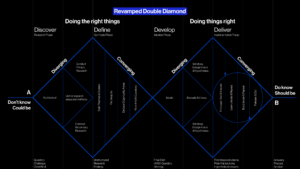
The power of this model is that at each part of the process, you’re widening and then constricting your creative lens, broadening your thoughts to find unturned stones, then condensing them into practical options. The ‘four D’s’ of design thinking are also known as the ‘five P’s’, or in our case the ‘three I’s’.
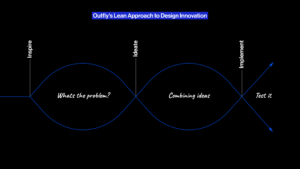
The first step of this framework revolves around the same question, asked twice: “What’s the problem?” Usually the core block to creative thinking is that you’re thinking about the wrong problem, and are in fact addressing the symptoms of a larger problem hiding behind it. Every business is built on addressing consumer needs, fixing a problem. Design Innovation as a continual process shifts innovation from being product-focused to human-centric, asking and re-asking the same question, “What problem are we solving now?”
This is the part where you come up with ideas. To keep up with your new, continuously evolving customer needs, you’re going to need a lot of them. The important part here is simply to generate ideas. No wrong answers, no stupid questions, just as many as you can. The ideation process can take many forms, but always revolves around refocusing perspective then combining ideas. Once you’ve generated your ideas (most of which will be terrible) you need to continue to develop them until they can stand for themselves.
Ideation works best when it reacts to changing circumstances, when it happens continuously, and when it’s baked into the brickwork of company culture. This is still meaningless unless the outcomes are prototyped, tested and built. Many organisations stumble at this hurdle. The success of putting ideas into practice depends on a leader’s ability to instil an internal culture that encourages ideation, creation, and iteration — and their willingness to actually act on them.
Design Innovation is asking creative questions, thinking of creative answers, then putting them into practice, but, like, actually doing that. Outfly
Large companies struggle most with this. They fall into the trap of performative innovation theatre, gesturing at the idea of being at the cutting-edge while their own rigid processes create an environment that hinders true innovation. As disruptors become incumbents, making an unexpected move starts to seem dangerous.
Often without knowing it, the lean startup is built to practice Design Innovation. Conceive, develop, prototype, perfect. This is what gives them the edge. At Outfly, we don’t just want our ideas to be implemented, we want to help change the way our clients approach innovation. The best single piece of advice we can give you is to instil creative confidence in your workplace. Remove the idea of the ‘stupid idea’. That starts with leadership. Be bold, be flexible. But, above all, be humble.